
Lincoln County Projected Versus Actual Release
A projected release date assumes that the present sentence calculation remains valid. NMCD builds that forecast from the judgment and sentence, presentence confinement credit, consecutive or concurrent counts, credits earned or lost, and credits expected in the future. The New Mexico Sentencing Commission distinguishes that projection from a flat-time date, which assumes no future earned deductions. Actual release is the dated event showing what happened after all legal and administrative checks.
A pretrial person at Lincoln County Detention Center usually has no computed sentence-end date. Release may turn on a bond order, conditions set by the Twelfth Judicial District, dismissal, or transfer. Even a sentenced county-jail detainee needs a local computation. NMCD’s state-prison deduction rules cannot be copied into the county calculation.
- Parole eligibility date
- The point when the Board may act in a case that requires a parole decision.
- Projected release date
- An administrative forecast that assumes applicable future credit.
- Full-term date
- The sentence end without unearned future reductions.
- Actual release
- The recorded departure or transfer event.
Find a Lincoln County Projected Release
Begin with custody type. The NMCD offender search covers people committed to state corrections, not Lincoln County jail-only records. Search by first and last name or NMCD number and use Include Inactive when an older state record may matter. The public portal has a CAPTCHA, and research did not verify that every inactive profile keeps a projected or actual date. A portal omission is a reason to seek the calculation record, not proof that no date exists.
- Confirm whether the person is at LCDC, in NMCD, or held for another authority.
- For NMCD custody, search by name or offender number and compare all identifiers.
- Request the current Offender Management Services calculation sheet if the date is absent or disputed.
- For a county sentence, obtain the signed judgment, jail computation sheet, presentence credit, and hold information.
- Check the planned destination and later actual release record before treating the forecast as community release.
The captured NMCD portal displays the fields and filters used for this first check. Visit the official search to review current fields.
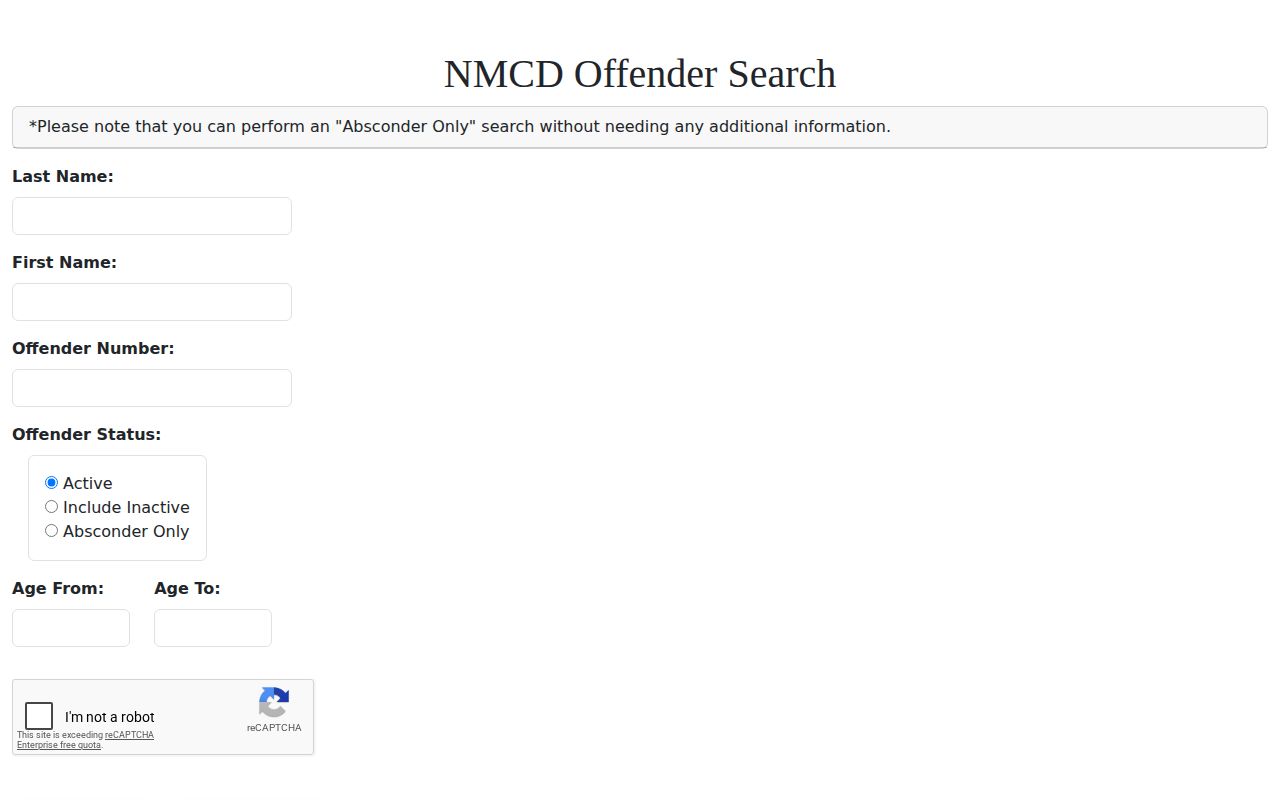
Include Inactive can help with former NMCD subjects, while Absconder Only concerns supervision and is not a projected-date filter.
NMCD Lincoln County Release Calculations
NMCD Records and Classifications says Offender Management Services performs sentence audits and release-date calculations. A useful request asks for the current calculation sheet, judgment used, presentence credit, full-term date, parole eligibility, credits awarded or forfeited, projected release date, and planned release destination. The agency’s internal forms distinguish discharge, detainer, parole, probation, federal custody, and treatment housing.
That destination field matters. Reaching a state projected date under “detainer” can end NMCD custody while another agency takes control. “Parole” means prison confinement changed to community supervision. “Discharge” is stronger evidence of a sentence ending, but another case can still exist.
The official Records and Classifications page explains NMCD’s calculation role and records coverage.
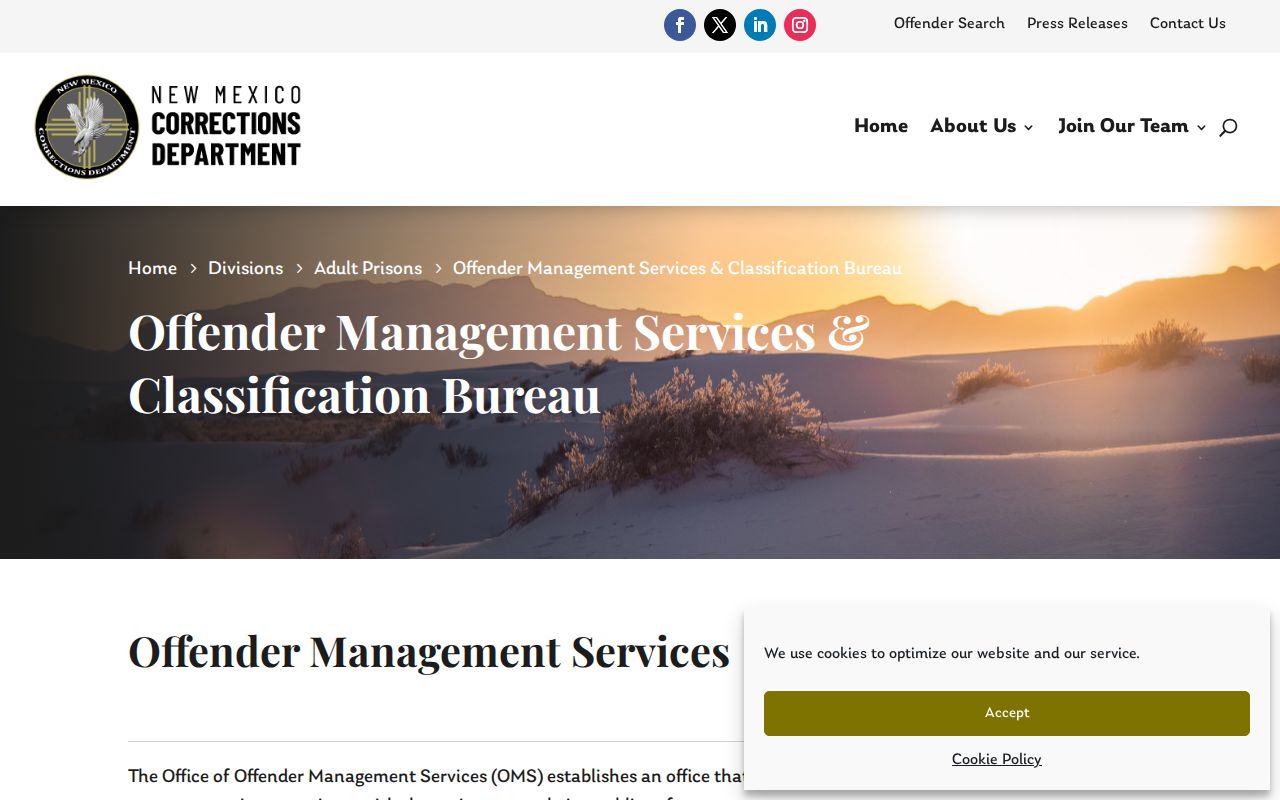
The screenshot identifies the office that should explain a state calculation, rather than leaving a family member to estimate a date from sentence length.
Use NMCD NextRequest for a written record request. NMCD identifies that portal as its regularly monitored virtual route. A focused request is more useful than asking for a whole inmate file, which may contain confidential reports and other protected material.
New Mexico Earned-Time Release Rules
New Mexico’s current meritorious-deduction law is NMSA 1978 §33-2-34, as amended by 2025 SB 375. It provides prospective deductions at admission for the sentence portion left after presentence credit. The maximum is four days per month for a serious violent offense and 30 days per month for a nonviolent offense. Parole-revocation confinement uses the classification of the underlying offense. Life and life-without-parole sentences do not receive these deductions.
The law also provides certain lump-sum deductions. Examples include approved vocational, substance-use, or mental-health programs, a high-school-equivalency credential, and higher-education awards. Each has statutory amounts and cumulative limits. Credits may be forfeited for discipline or failure to take part in approved programming.
Do not apply a universal “85 percent rule.” The present statute states a maximum of four days per month for a serious violent offense. Sentence structure, presentence credit, lost credit, lump-sum awards, month lengths, and offense classification all affect a real calculation. Some classifications also depend on a sentencing-court finding about the offense’s nature and harm.
Note: The current NMCD calculation, not a hand estimate, is the sound source for an individual projected release date.
Lincoln County Jail Release Computations
No official Lincoln County jail earned-time policy was found. That gap must remain visible. Section 33-2-34 applies to designated corrections facilities and does not automatically establish the formula for an LCDC sentence. A county date requires the judgment, sentence start, presentence credit, any jail computation sheet, all active cause numbers, and any hold or detainer.
Call Lincoln County Detention Center at 575-648-6510 for present status. For the legal basis, use the Twelfth Judicial District contacts to request the judgment, amended judgment, bond order, or later order. For documentary proof of departure, submit the county’s IPRA request for the release entry and log.
A current court order may precede physical release because staff must complete identity, warrant, property, and transport checks. Ask for both the court timestamp and actual jail release time. Their difference often reflects two stages, not a bad record.
Why Lincoln County Release Dates Change
Projected dates move when facts inside the sentence calculation change. Other events can leave the date intact but change the destination. The distinction is important when someone expects community release and another agency has placed a valid hold.
| Factor | Possible effect | Record to check |
|---|---|---|
| Credit earned | May move the projection earlier within the law | OMS calculation sheet |
| Credit forfeited | May move the projection later | Disciplinary and calculation record |
| Amended judgment | Can change term or presentence credit | Signed court order |
| Consecutive counts | May extend the combined term | Judgment and sentence audit |
| Detainer or hold | May change community release into transfer | Hold and destination fields |
| Parole plan | Approval or conditions may affect movement | Board and P&P records |
A parole eligibility date also differs from a projected release date. Eligibility marks when the Board may act. Projection estimates a sentence-based movement or end point. Neither substitutes for the actual record.
Audit a Lincoln County Release Projection
A careful review begins with every signed and amended judgment. List the sentence start, each count, whether terms run together or one after another, and the presentence confinement credit. Then compare those facts with the OMS sheet’s full-term date, offense classification, awarded and lost deductions, and projected release date.
Ask NMCD to explain a mismatch. Do not create a personal calculator from sentence length alone. Such a shortcut hides court amendments, multiple cause numbers, parole revocation, lost credit, and changes in destination. For LCDC, direct the same questions to the court and jail record custodians because the NMCD formula may not apply.
Finally, check for a detainer and an approved parole plan. A reached date can result in transfer, treatment housing, probation, or parole. The projected date page on the internal form is a planning tool, not proof that the person walked out of custody.
Lincoln County Release Credit Records
Presentence confinement credit is time the sentencing court credits for qualifying custody before the sentence calculation begins. It is not the same as future meritorious deductions. Consecutive terms run one after another, while concurrent terms run at the same time to the extent ordered. Those words in the judgment can change the result far more than a rough count of months.
NMCD’s external-placement case-summary fields show the parts worth requesting: good-conduct time, parole eligibility, projected-date calculation, full-term date, time served, and presentence credit. The form proves that these concepts take part in administration. It does not prove that each one appears on every public portal result. Ask OMS for the releasable calculation when the public profile is thin.
A lump-sum program award also needs documentation. Completion alone does not justify adding a credit to a personal estimate. The statutory category, award decision, cumulative cap, and any later forfeiture belong in the current calculation sheet.
Lincoln County Release Destinations
A projected date should always be read beside its destination. NMCD policy forms include sentence discharge, detainer, parole, probation, federal custody, and treatment housing. Only some of those paths place a person in the community without another custodial step. A federal or other-agency destination means one system’s release can be another system’s intake.
Lincoln County has a special jurisdiction issue. County records document historical BIA detainees at LCDC. If a person held for an outside sovereign leaves the county facility, ask for the receiving agency and transfer entry. Do not label that event a community release unless the record supports it. No current official ICE contract was found, but an individual detainer can still affect a particular destination.
For travel or pickup plans, call the responsible facility near the expected date. Exact LCDC release times, exit points, weekend rules, and family waiting procedures were not published. A forecast should not be used as a promise of a specific pickup time.
Confirm Lincoln County Actual Release
Near the forecast date, verify the system again. LCDC can answer present physical status for a county detainee. NMCD can provide the current state calculation and later release record. The court supplies the order that changed custody. New Mexico VINE may send a pending or actual release notice, though it remains a notification aid rather than a release certificate.
The Lincoln County VINELink inmate search explains agency selection and transfer re-registration. A VINE alert from one facility may mean transfer to another. Confirm the destination before arranging transportation or stating that the person entered the community.
For a past event, request both the forecast and the final entry. Their difference can show credit loss, a later court order, delayed plan approval, or a destination change. Include the person’s full name, offender or booking number, and a narrow date range. If NMCD was involved, ask for the final release or discharge record and the calculation version in effect just before release. If LCDC was involved, ask Lincoln County for the time-stamped release log and any destination or receiving-agency field that can be disclosed.
Keep each agency’s answer in its proper scope. A court order states legal authority. The jail log states the end of local physical control. NMCD records state the end or change of state custody. A P&P entry states community supervision. Together they can resolve “when were they released” without treating one forecast as the whole record.